
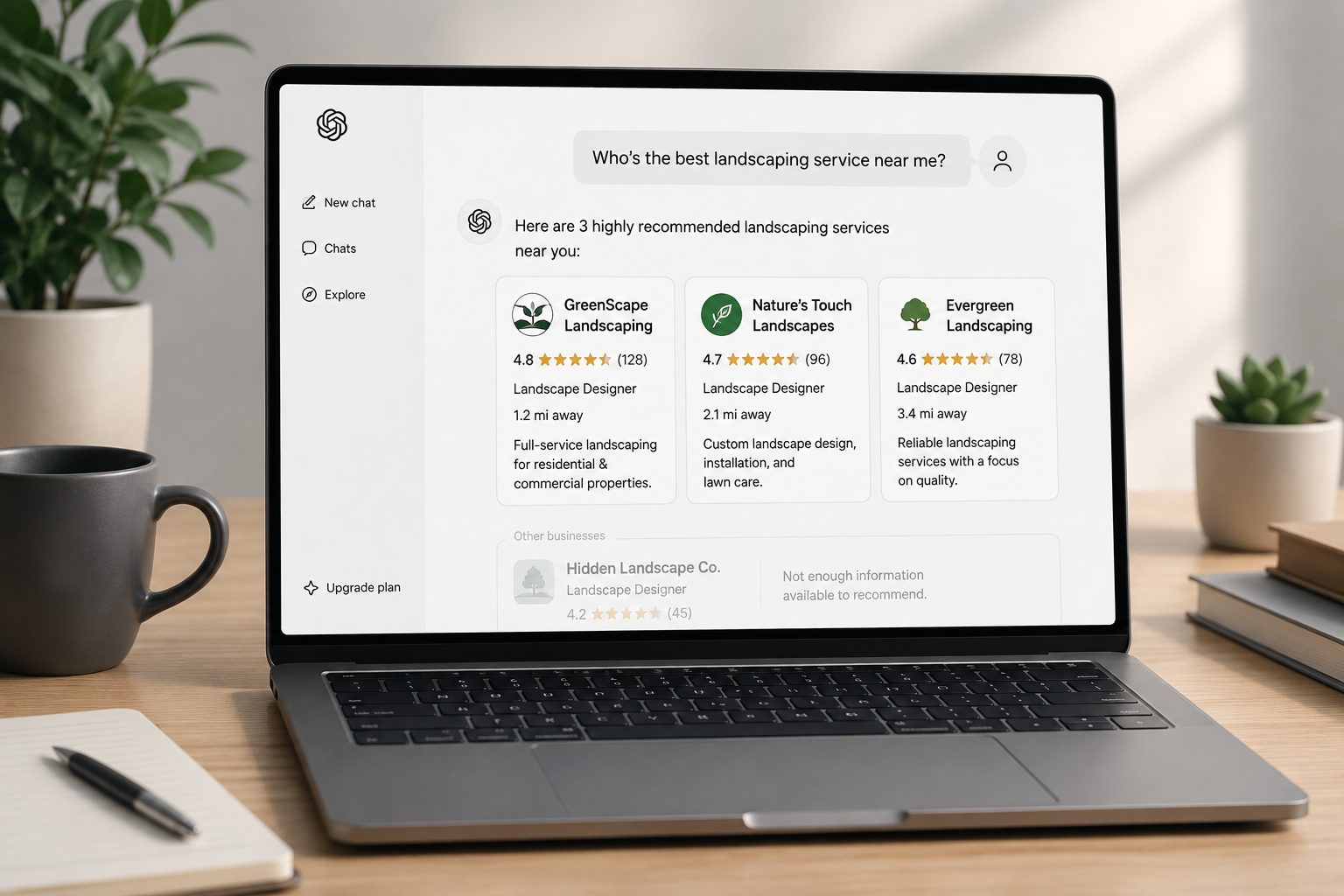
Open ChatGPT right now. Ask it to recommend a plumber, an interior designer, a restoration company, whatever you do, in your city.
Did your business come up?
For a lot of owners, the answer is no. And the more uncomfortable part: their competitor did.
This isn't a niche behavior anymore. In BrightLocal's March 2026 consumer survey, 45% of consumers said they'd used AI tools to find or choose a local business, up from just 6% the year before (BrightLocal Local Consumer Review Survey, March 2026, n=1,002 US adults). ChatGPT led the pack at 31%, with Google's AI Mode close behind at 23%. Nearly two-thirds of the people using these tools said they trust the recommendations they get.
Here's the part almost nobody is talking about: people who find you through AI tend to be much better customers. Semrush's July 2025 analysis of AI search traffic found the average AI search visitor was worth roughly 4.4x the average traditional organic search visitor. That tracks with what we see in client accounts. Someone who arrives because an AI recommended you isn't shopping around, they're already halfway sold.
So AI visibility for local business isn't a 2028 problem. It's a this-quarter problem.
The good news: almost none of it is technical. Below are six checks you can run on your own business, mostly from your phone. No tools to buy, no code to write.
Check 1: Run the actual test
Before anything else, get your baseline. Open ChatGPT, Google's AI Mode, and Perplexity, and ask each one the way a real customer would:
- "Who's the best [your service] in [your city]?"
- "I need a [your service] near [neighborhood], who should I call?"
- "Recommend three [your industry] companies in [your city]."
Then ask a follow-up: "Why did you recommend those?" The AI will usually tell you what it found: reviews, a website, a directory listing. That answer is your roadmap.
Write down what you see. Who showed up instead of you? What did the AI say about them? If you're mentioned but the details are wrong, an old phone number, the wrong service area, a service you dropped three years ago, that's its own problem, and it's fixable.
What good looks like: your business appears in at least one of the three, with accurate details.
Check 2: Does your website actually answer questions?
AI doesn't recommend the prettiest website. It recommends the one that answers the question.
Think about what customers ask you every single week. How much does this cost? How long does it take? Do you handle that specific situation? Are you licensed and insured? Do you service my area?
Now go look at your website. Is any of that written down?
For most businesses, no. The site says "quality service since 1998" and answers nothing. Meanwhile the competitor who published a plain-English FAQ page is the one getting quoted.
Your quick win this week: write down the ten questions you answer on the phone most often. Put them on your site with the question as the heading and a straight, direct answer immediately underneath. Details after. That format, question then answer, is exactly what AI tools are built to pull from.
This is the foundation of how we approach SEO in the AI era.
Check 3: Is your Google Business Profile actually alive?
Your Google Business Profile isn't just for Maps anymore. It's one of the first places AI looks when it's deciding which local businesses to name.
Three things to check this week:
- Category and services. Is your primary category exactly right? And have you added all your services, not just the main one? Most profiles list two or three when the business offers fifteen.
- Signs of life. Photos and posts from this year, not 2022. A dead profile reads as a dead business, to machines and to people.
- The Q&A section. You can ask and answer your own questions there. Almost nobody does it. It's free, it's fast, and it's a direct feed of clear answers about your business.
Fifteen minutes of cleanup here beats months of guessing.
More on local SEO and Google Business Profile optimization.
Check 4: Read your reviews the way AI reads them
AI doesn't just count your stars. It reads what your customers wrote.
When someone asks an AI "who's the best restoration company near me," it's pulling from review content, the actual sentences. A review that says "they handled our water damage overnight and walked us through the insurance claim" teaches the AI what you do, how you do it, and how well. A review that says "great job!" teaches it nothing.
Three levers, in order of impact:
- Recency. A steady trickle of new reviews beats a pile from three years ago.
- Detail. Ask happy customers to mention the specific job. It happens naturally if you just say, "Would you mind mentioning the kitchen remodel?"
- Your replies. Responding in plain language is trust evidence too, and it's public text about your business that you fully control.
Reply calmly to the bad ones as well. AI reads those. So do humans.
Check 5: Are you accidentally blocking AI?
Some businesses are invisible to AI for one silly reason: their website tells AI to go away.
There's a small file on every website called robots.txt that says which automated visitors are allowed to read the site. Some sites block AI crawlers without the owner ever knowing, usually a leftover setting from a developer or an old plugin.
If ChatGPT and the others literally cannot read your site, nothing else on this list matters.
You don't need to fix this yourself. Just send your web person one sentence:
"Are we blocking AI crawlers in our robots.txt?"
That's it. If they look confused, that's a red flag by itself.
An honest aside, since you'll hear about it: there's a newer file called llms.txt that some people are pushing hard as an AI visibility must-have. The truth is the major AI companies haven't confirmed they use it. It's cheap to add and it won't hurt you, but it isn't the thing that matters. Access is what matters. Don't let anyone sell you a package built around it.
Check 6: Show up in more than one place
Here's the biggest one, and it isn't your website.
AI recommends businesses it keeps seeing. Your website, your Google profile, Yelp, industry directories, the chamber of commerce, local news coverage, Facebook. When your name shows up consistently across multiple sources, AI treats you as a real, established business. One lonely website is easy to skip.
Two rules:
- Be in more places. Directories, associations, local press, supplier and partner sites.
- Be consistent. The same business name, the same address, the same phone number everywhere. Mismatches make machines hesitate, and people too.
Quick audit: search your business name in quotes. Is what comes back current, consistent, and more than just your own site?
What all six have in common
None of this is technical. Look back at the list: answer real questions, keep your Google profile alive, feed your reviews, don't block the crawlers, show up in more than one place, and check what the AI actually says about you.
It's just being findable on purpose.
And notice something else: every one of these is good old-fashioned SEO. Clear content, strong local signals, a clean site, real trust signals. AI visibility isn't a separate discipline that replaced SEO, it's what happens when the SEO fundamentals are done well and structured so a machine can read them.
Ready to see where you actually stand?
If you ran the test in Check 1 and came up invisible, you're not behind, you're early. Most local businesses haven't looked at this at all.
Run our free AI Visibility Scorecard to get a score across all of these checks in a few minutes.
Or if you'd rather someone just ran the whole review for you, that's what we do. Book a free consultation and you'll speak with the person who would do the work.