
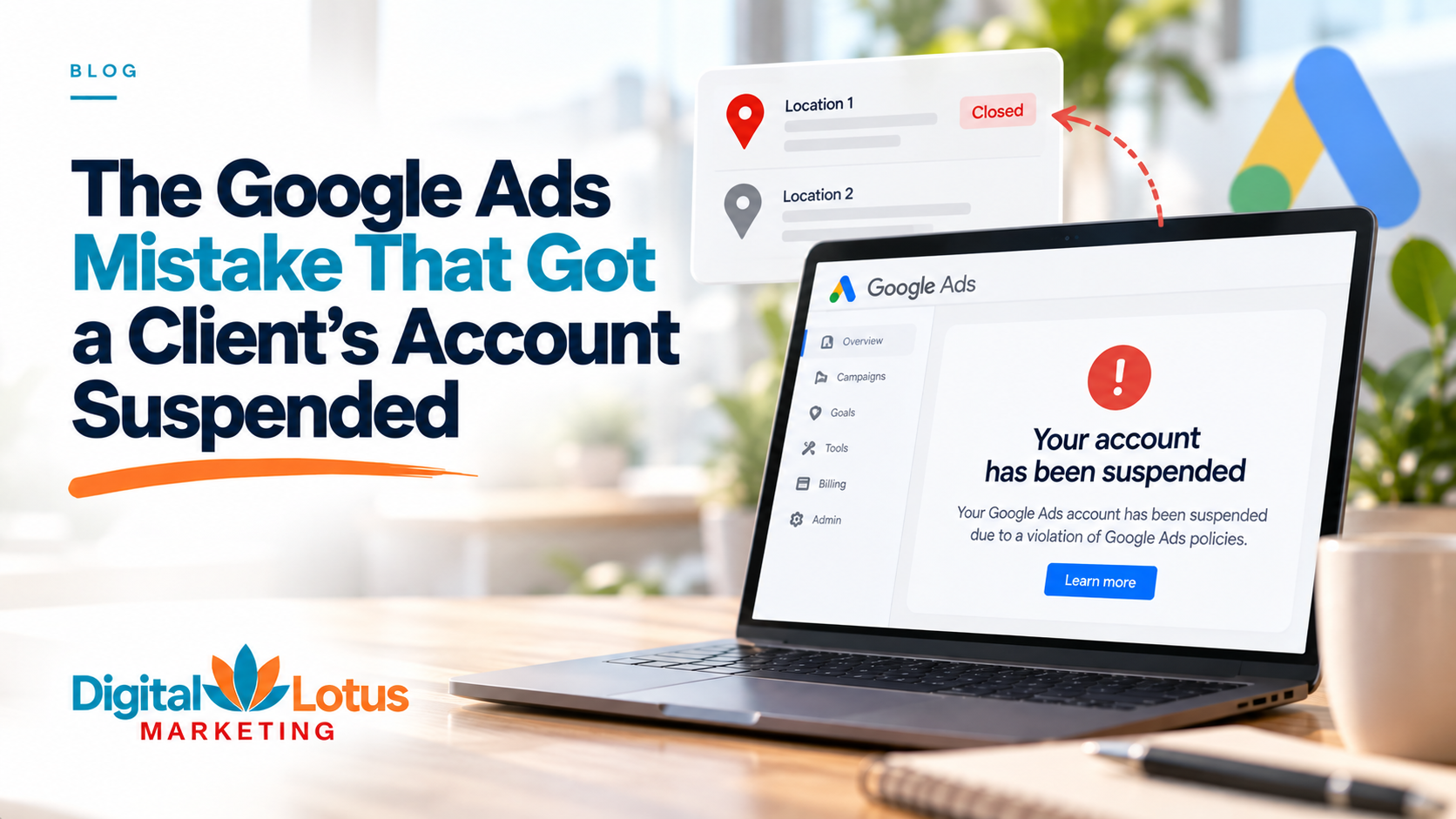
When a business calls me because their Google Ads account is suspended, the reason is rarely exotic. It is almost always something small that no one was watching.
That was the case with a Conejo Valley client who came to us after their account went dark. They had been running Google Ads with another agency, but "running" is a generous word for it. There were no monthly check-ins. There was no working cadence. Maybe a quarterly call, or an email thread that trailed off, and otherwise the campaigns were left alone to work or not work.
When we got into the account and started tracing what had triggered the suspension, we found the answer in the business information section. The account still listed two physical locations. The problem was that the business had closed one of them a while back. That old address had never been removed. Every signal Google was reading from the client's website and their Google Business Profile pointed to one address. Google Ads was still shouting about the other. Google's systems saw the mismatch and shut the account down.
That is the whole reason. A closed location no one bothered to remove from the account. A signal so obvious that anyone glancing at the account each month would have caught it inside a minute.
We fixed it. The suspension was straightforward to appeal once the addresses matched across every property. But the moment I want you to sit with is not the fix. It is the "how did we get here." Because a business does not lose the ability to run Google Ads over one clerical detail. It loses it because that clerical detail sat there, unwatched, for months.
What "unwatched" really costs
The suspension itself was a headache. The bigger problem was what we found once the ads were running again. When we went deeper into the campaign performance, the picture got worse. Quality scores were low across the board. The ad copy did not match the landing page experience. Keywords that should have been negatives had been eating budget for who knows how long.
Yes, the account had been sending traffic to the site. But it was not optimized traffic. It was expensive, badly matched, and pointed at pages that were not built to convert.
Digging out took time. We rebuilt the campaign structure. We rewrote ad copy so it actually reflected what the landing page offered. We added negative keywords in tight rounds and watched what happened. We monitored quality scores until they moved. CPCs came down. Conversions started to look like conversions again.
Honestly, it probably would have been faster to start a brand new account. A new account would not have started at a disadvantage. You can read the fuller turnaround in our success story with this client. The point is that recovery took months, and it started from behind.
Google Ads is not set-and-forget
I want to be direct about this because it is where a lot of businesses get burned. If your expectation is that you set up an ad, let it run, and consider the job done, you are going to run into trouble. Google Ads change on a regular basis. Auction dynamics change. New match types roll out. Old campaign types get sunsetted. New AI-driven options appear, and each one has trade-offs that only a human watching the account can weigh.
Somebody needs to be looking at your account. Weeding out negative keywords. Reading the search terms report. Watching quality scores. Reviewing where the ads are landing and whether that page is doing its job. Testing different copy. Trying to move the needle on cost per click and conversion rate. That is not a quarterly job. It is a weekly, sometimes daily, job.
When it comes to Google Ads, we are particularly careful because it is our clients' money that is going out every day.
Leena Roy
That is why we treat these accounts with a kind of vigilance that surprises people. Every dollar going out has to be doing work. We cannot afford irrelevant keywords eating budget. We cannot afford landing pages that leak. Even in a world of AI-driven campaign types, we stay measured with which levers we pull and when.
Where AI options fit, and where they do not
There is a real push right now from Google toward AI Max, Performance Max, and other AI-assisted campaign types. Some of these are genuinely useful. For certain businesses, Performance Max in combination with search campaigns can be a strong pairing. AI Max is starting to work well for a few of our clients too.
But not for everyone.
For a business with a small budget, opening things up to campaign types that pull in a wide surface of inventory and search terms can burn through spend fast. It is not that these options do not work. It is that they work in the right circumstances, and part of our job is to know when your business is one of those circumstances and when it is not.
We do not treat AI options as bad. We do not treat them as automatic goods either. We limit what needs to be limited. We open up what can be opened up. We keep a hand on the wheel.
About the Google rep advice
This one comes up often. Business owners will tell me they have been running their own Google Ads and getting advice directly from their assigned Google rep. There are real gems of advice in those conversations. Google reps know the platform, and some of what they suggest is genuinely useful.
But their incentives are not your incentives.
A Google rep's goals are tied to helping businesses grow, get results, and also spend more. All three things can be true at once. That means the advice you get from a Google rep tends to push toward opening things up, raising budgets, and adopting new features. Sometimes that is right for your account. Sometimes it is not. We are selective about which pieces of Google rep advice we take, because our job is to make the most of your budget, not the most of Google's revenue from your budget.
What to check if you suspect the account is drifting
If you are reading this because your own Google Ads account has been suspended, or because you suspect the people running it are not really running it, here is what to look at.
Ask how often the account is reviewed. Not "how often do we talk," but how often does someone actually open the account and look at search terms, quality scores, and negative keyword lists. If the answer is "quarterly" or "when there's a problem," that is your problem.
Ask what they change month to month. A well-run Google Ads account is never static. Copy gets tested. Bidding strategies get adjusted. Landing pages get feedback. If the reports you receive look identical month over month, no one is doing the work.
Ask about the business information in the account. This one is boring, and it is exactly the kind of boring that got the Conejo Valley client suspended. Addresses, phone numbers, business names, and everything that connects to your Google Business Profile need to be consistent. Any change to your business needs to flow through every property, including Ads.
Ask how they think about AI options. Not "do you use them" but "how do you decide when to use them." An agency that turns everything on because Google recommends it is not doing your budget any favors. Neither is one that refuses to test anything new.
Digital Lotus works with businesses across Thousand Oaks and the greater Conejo Valley. Every Google Ads account we run gets weekly attention, tight campaign structure, and human oversight on which AI-driven options make sense for that specific business. If you want a second set of eyes on your account, or you are past the point of second opinions and just want it fixed, book a free consultation and we will take a look.
FAQ
Why does Google suspend ad accounts?
Google suspends ad accounts for a range of reasons, from policy violations in ad copy to inconsistencies in business information to suspicious billing activity. In our experience, the most avoidable suspensions come from inconsistencies: a phone number, address, or business name in the Google Ads account that no longer matches what appears on the business's website or Google Business Profile. Google's systems compare those signals, and when they conflict, a suspension often follows.
Can a suspended Google Ads account be recovered?
Usually, yes. The first step is identifying what triggered the suspension, which Google will state in general terms inside the account. Once the underlying issue is fixed (an outdated address updated, a policy-violating ad removed, verification completed), you can file an appeal. Recovery is faster when the fix is verifiable and the reason for the suspension is clearly documented.
Is a recovered account as effective as it was before?
Not always. The suspension itself is often only the surface issue. Accounts that have been left without oversight tend to have deeper problems, including low quality scores, poorly matched keywords, and landing pages that hurt conversion. Getting the account unsuspended is step one. Rebuilding performance is a separate project, and it can take months.
Should I use Google's AI campaign types like Performance Max or AI Max?
Sometimes. Performance Max and AI Max can work well when combined with well-structured search campaigns, particularly for businesses with the budget and inventory to absorb wider targeting. For small-budget accounts, opening everything up to AI-driven campaign types can burn through spend on low-intent traffic. The right answer depends on the business, and it needs to be revisited as the account matures.
How often should someone be reviewing my Google Ads account?
Weekly, at minimum, for active accounts. That review should include search terms, negative keyword additions, quality score checks, and a look at landing page performance. Quarterly reviews are not enough to keep an account healthy on a platform that changes as often as Google Ads does.