
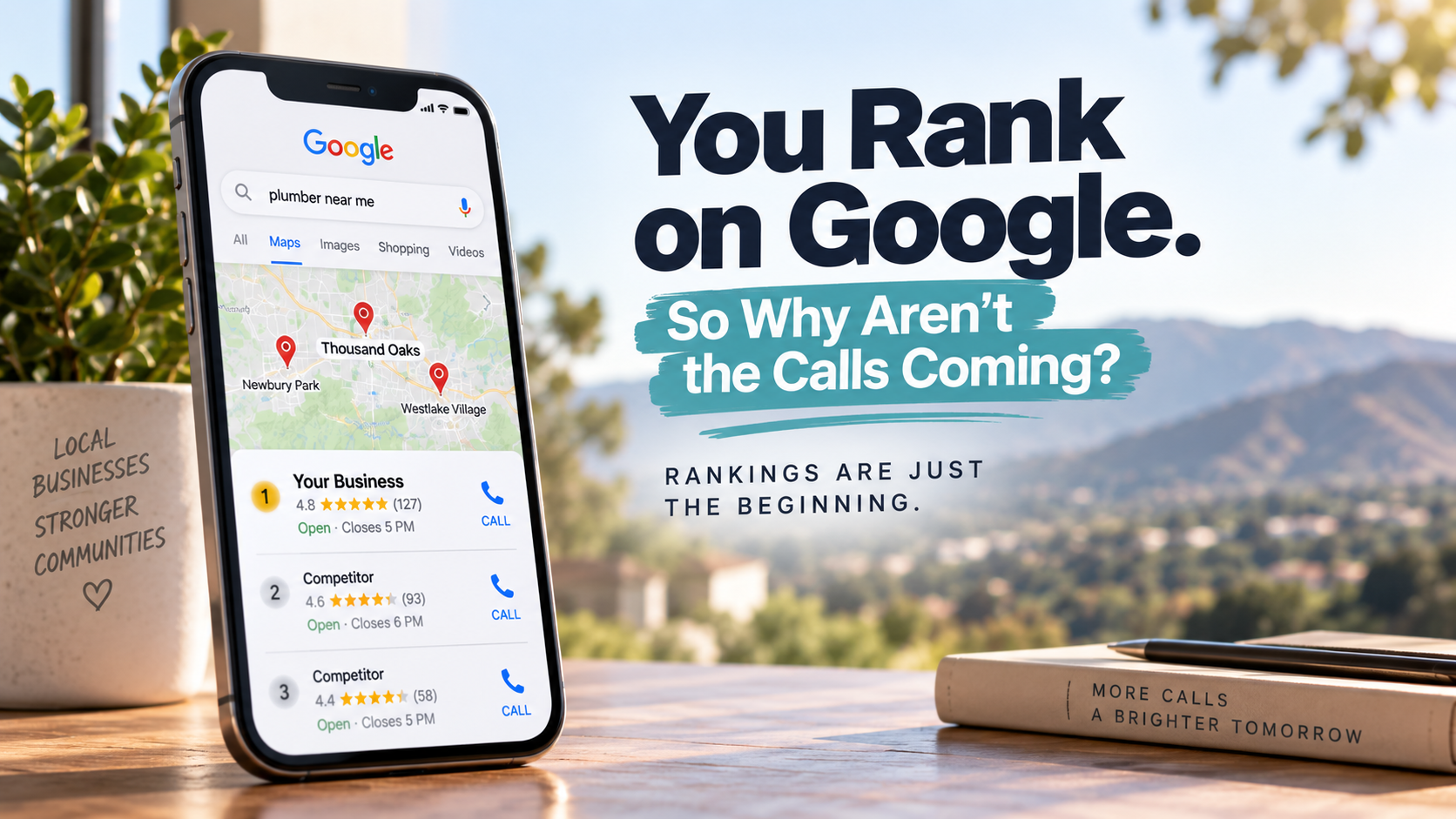
You've done the work. Your Google Business Profile has a real listing, a real category, real hours. When you search your service and your town, there you are in the map pack, sitting comfortably in the top three. You should be booked out.
Except the phone isn't ringing.
This is one of the most frustrating positions a small business can be in, and I see it every week. Ranking in the map pack is not the finish line. It's the doorway. If the listing behind that doorway doesn't answer the question the searcher came in with, they scroll past you and call the business underneath you. Here is what I actually find when I go under the hood on a listing that ranks but doesn't convert.
Your service area is drawn too wide
I worked with an ADHD coach in Southern California who had been in business for years and had real presence, but their local-area rankings were soft. The first thing I noticed was the service area. They had drawn it huge, hoping to catch every possible client across a two-hour radius.
Google's map algorithm reads a wide, sprawling service area as a signal that you are not really local to any of the places inside it. Local pack rankings weight proximity, and proximity is measured against a defensible service radius, not an aspirational one. When your area covers three counties, you rank weakly in all of them instead of strongly in the one you actually serve.
If you are a service-area business in Thousand Oaks and your radius stretches from Santa Barbara to downtown Los Angeles, tighten it. You will rank higher for the towns you can actually get to.
Your description doesn't say what you do
The second thing I found on the ADHD coach's profile: the business description did not mention ADHD. Not once. It did not mention the specific towns they served either. The description read like something written for a human friend who already knew what the business did.
Google is not that friend. The business description is one of the strongest textual signals Google uses to decide which searches you belong in. If the words your customers type are not in your description, in your services, and in your categories, the map pack picks someone whose profile does contain those words.
Two questions to ask about your own description right now:
- Does the exact phrase a customer would type appear in the description, in plain words, near the top?
- Do the neighborhoods or cities you serve appear in the description, by name?
If either answer is no, you have a fix that costs nothing and can move rankings inside a couple of weeks. That was most of what moved the ADHD coach into the map pack. A tighter service area, and a description that finally said what they did and where they did it.
You optimized it once and walked away
A Google Business Profile is not a set-it-and-forget-it asset. It behaves more like a social account than a static listing. Google rewards freshness, and dormant profiles slide.
Here is what "active" looks like in practice:
- New photos every month. Real photos, not stock. Interior, exterior, staff, work in progress, finished jobs.
- Services and products kept complete. Every service you offer, each with its own description containing the keyword for that service.
- Q&A section owned by you. If a real customer asks a question, you answer it. If nobody has asked the obvious questions, you post them and answer them yourself.
- Posts published regularly, even short ones, tied to what you actually do that week.
Most profiles I audit have not had a new photo in over a year. That alone puts you behind any competitor who is still tending theirs.
Your reviews aren't doing the work reviews need to do
Reviews are one of the strongest ranking signals in the map pack, and one of the strongest conversion signals once a searcher sees your listing. Both matter. Ranking gets you seen. Reviews get you called.
If you have 14 reviews and the business under you has 240, ranking above them in one search on one day is not going to change what happens when both listings appear side by side. The searcher taps the one with the social proof.
A review process is not complicated, but it has to exist. Ask every satisfied customer, the same way, every time. Make it easy (a short link, a QR code on the invoice, a follow-up text after the job closes). Respond to every review you receive, positive or negative, in your own voice. Google's algorithm reads the response activity as an active-business signal. Prospective customers read it as a "these people actually care" signal. You need both.
The AI layer changes the stakes
Ranking in the map pack has always been worth doing. It is worth doing more now, because a growing share of local searches never see the map pack at all. According to BrightLocal's Local Consumer Review Survey (March 2026, n=1,002 US adults), 45% of consumers have used AI tools for local business recommendations, up from 6% in 2025. When ChatGPT or Google's AI Mode answers a "best ADHD coach near me" question, it pulls from the same signals that build your Google Business Profile: your description, your services, your reviews, your consistency across the web. A profile that ranks in the map pack but is thin on content is also invisible to the AI layer. The fix for one is the fix for both.
The Conejo Valley angle
If you serve Thousand Oaks, Newbury Park, Westlake Village, or anywhere else in the Conejo Valley, the local search market is competitive but winnable. It is not New York or Los Angeles. Most of your competitors are in exactly the same state as the ADHD coach was: a listing that exists, a description that doesn't sell, a service area that is too wide, a review count that has been static for a year. If you close those gaps before they do, the map pack starts sending you the calls it was supposed to send you all along.
A lot of times people just create it and leave it. They don't update it, they don't add more photos, and they don't keep it ongoing.
Leena Roy, Founder, Digital Lotus Marketing
What to do this week
Open your Google Business Profile and, in one sitting:
- Tighten your service area to the towns you can actually reach.
- Rewrite the description so the first two sentences contain the exact service a customer would type, and the neighborhoods you serve.
- Add ten new photos.
- Fill out every service, each with a two-sentence description that includes the keyword for it.
- Respond to every review you have not responded to.
That is one afternoon of work. In my experience with well-established service businesses, it is often enough to move a listing from "ranking but quiet" into "ranking and ringing".
If you would like a second pair of eyes on your profile before you spend that afternoon, our team offers a focused Google Business Profile audit that flags exactly what is holding your listing back and what to fix first.
FAQ
I rank in the top three of the map pack. Why am I not getting calls?
Ranking is only half the job. Once a searcher sees your listing, they compare it against the other two. If your review count is low, your photos are old or missing, your description doesn't clearly say what you do, or your hours or phone number look off, they pick a competitor. Map pack ranking gets you seen. Everything inside the listing decides whether you get called.
How wide should my service area be on Google Business Profile?
As wide as you can genuinely serve, and no wider. Google reads an oversized service area as a weak local signal, so a business claiming three counties often ranks worse in each of them than a competitor who claims only one. Set the radius or the town list to match where you actually take jobs.
Does the business description on Google Business Profile really affect rankings?
Yes, meaningfully. The description is one of the textual signals Google uses to decide which searches your profile should appear in. If a keyword your customers type is not in your description, services, or category, you compete at a disadvantage against a business whose profile contains those exact words.
How often should I update my Google Business Profile?
Treat it like an active channel, not a static listing. New photos monthly, new posts at least twice a month, services and Q&A kept current, reviews responded to as they come in. Dormant profiles lose ground to profiles that are being tended, even when the underlying business is stronger.
How many reviews do I need to compete in the local pack?
There is no universal number. What matters is that you are within striking distance of the other two businesses in your local pack, and that your review activity is recent and ongoing. A profile with 40 reviews collected steadily over the last year will usually out-convert one with 200 reviews that stopped two years ago.