

If you're running a small business, you know the drill. You’re not just the CEO; you’re the head of sales, customer service, accounting, and, of course, marketing. Juggling all those roles is tough, but marketing often feels like the trickiest hat to wear.
The truth is, the core marketing challenges for small businesses almost always come down to the same five pressures: making a shoestring budget work, actually getting noticed online, standing out when you have a dozen local competitors, finding the time and know-how to do it all, and figuring out if any of your efforts are even paying off.
Confronting Small Business Marketing Realities
Forget the corporate jargon and complex theories. This guide is built for the real world you operate in every day. We're going to tackle those five fundamental challenges head-on with practical, no-fluff advice.
Think of this as your roadmap. For every hurdle we identify, we’ll lay out clear, actionable steps you can take. The goal is to move past the frustration and start turning these common problems into real growth opportunities.
The Five Core Hurdles for Owners
Marketing a small business isn't like playing in the big leagues. You don't have a massive team or a bottomless budget. Every dollar and every hour has to count. These hurdles are all connected, too. A tight budget makes it harder to gain visibility, which in turn makes it tougher to compete.
You can see how these pressures all link together.
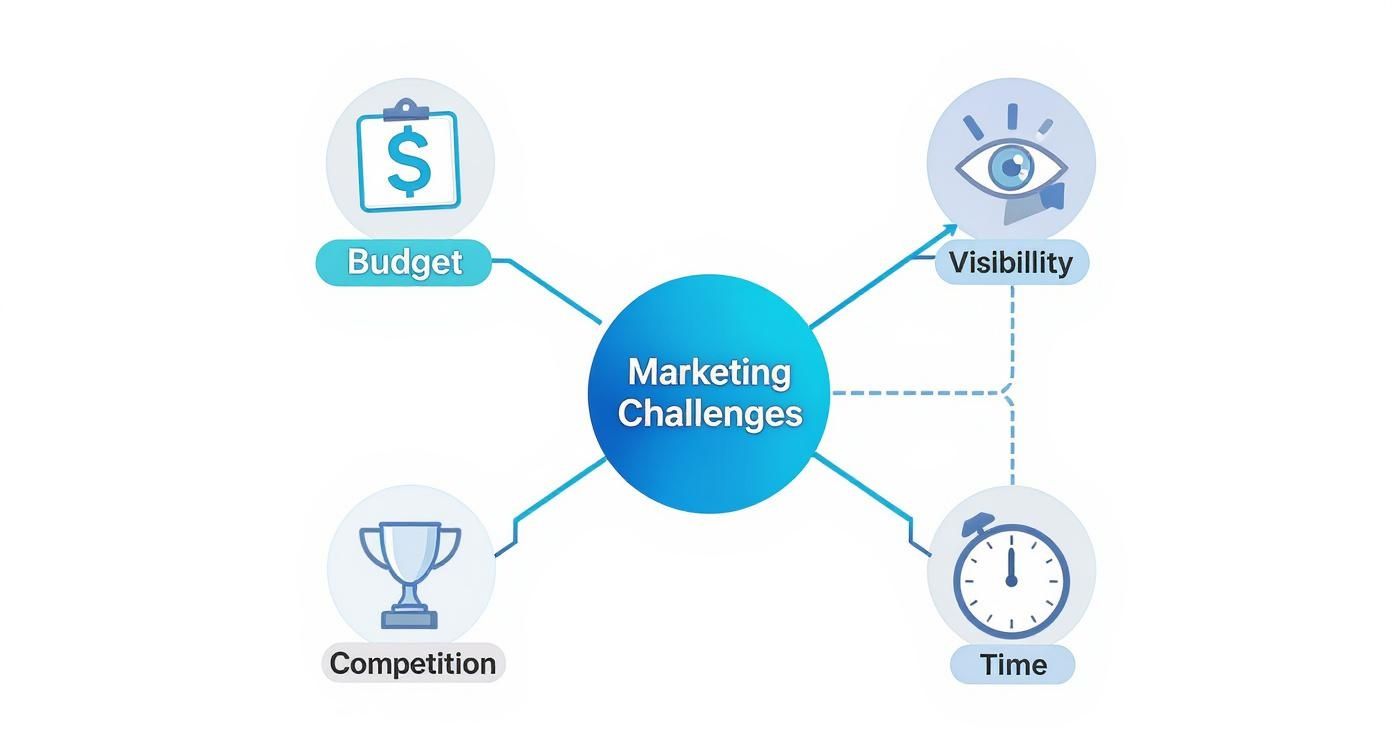
This map gets right to the point, showing how budget, visibility, competition, time, and ROI are the central obstacles you're up against.
Building a Practical Framework for Success
It's easy to feel overwhelmed, but the secret is to be systematic. When you address each challenge with a specific strategy, you start building a marketing machine that works for you, even when you’re short on resources. You’ve come to the right place for real answers.
The goal is to transform marketing from a daunting, time-consuming chore into a manageable, effective system that frees you up to focus on running your business. This means prioritizing high-impact activities and using smart tools to handle the rest.
A marketing automation for small businesses guide can be a game-changer here, as it lays out how to put repetitive tasks on autopilot so you can focus on the big picture.
Throughout the rest of this guide, we'll break down exactly how to:
- Maximize your budget: We’ll focus on low-cost tactics that deliver a real, measurable return.
- Boost online visibility: Learn straightforward SEO and content strategies to get in front of local customers.
- Differentiate your brand: Use your small size to your advantage and build genuine customer loyalty.
- Manage your time: Discover systems and tools that simplify your marketing workflow without breaking the bank.
- Measure what matters: We’ll show you how to track the numbers that directly impact your revenue.
1. Making Every Dollar Count with a Limited Budget
For most small businesses, the marketing budget feels less like a war chest and more like a piggy bank you're shaking for loose change. It’s tough. You see competitors running splashy ad campaigns, and it's easy to feel like you’re bringing a slingshot to a cannon fight. This is one of the most common and frustrating realities for small business owners, but a small budget doesn't mean you can't make a big impact.
The trick is to stop thinking about what you can't do and start focusing on what you can control. A limited budget forces you to be smarter, more creative, and more focused than your bigger competitors. You can't afford to waste a single dollar on tactics that don't deliver, which is actually a hidden advantage. It pushes you toward high-return, low-cost strategies that build a real connection with customers.
Prioritize High-Impact, Low-Cost Tactics
First things first: forget trying to compete with national brands on expensive TV commercials or billboard ads. That's not your game. Your strength is your local presence and the direct connection you can build with your community. The goal is to find the marketing channels where a small, smart investment can punch way above its weight.
Here’s where to focus your limited funds for maximum effect:
- Local SEO (Search Engine Optimization): This is all about making sure local customers find you the moment they search for what you offer. Optimizing your Google Business Profile is completely free and is arguably the single most powerful marketing tool you have.
- Direct Email Outreach: Building an email list lets you speak directly to people who have already raised their hands and shown interest in your business. It's a cheap, effective way to promote specials, share news, and build loyalty without constantly paying for ad space.
- Hyper-Targeted Social Media Ads: Instead of casting a wide, expensive net, you can spend as little as $5 a day on platforms like Facebook or Instagram to reach a very specific audience in your immediate area. You can target people by zip code, interests, and even recent life events.
Find Free and Affordable Marketing Tools
You don't need an enterprise-level software budget to look professional and manage your marketing efficiently. So many powerful tools are available for free or at a very low cost, which really helps level the playing field.
For example, you can design fantastic graphics for social media, flyers, and emails using free tools like Canva. There are free starter plans for email marketing platforms and free social media schedulers to help you stay consistent without being glued to your phone. These resources turn your effort into tangible results without draining your bank account.
The bottom line is this: a small budget demands smart, focused decisions. You have to learn to identify your most profitable marketing channels and pour your resources there, avoiding the trap of spreading yourself too thin across too many platforms.
This approach isn't just about saving money; it’s about making every dollar work harder for you. And the data backs this up. A 2024 survey showed that 27% of small business professionals see budget constraints as their biggest hurdle, second only to lead generation at 30%. Even so, 56% are still aiming to increase sales, proving that smart marketing is the bridge to growth. You can read the full research about these small business trends for more context.
Adopt a "Test and Measure" Mindset
With a tight budget, you simply can't afford to guess what works. Adopting a simple "test, measure, repeat" philosophy is essential. Before you go all-in on any single channel, run a small test.
For instance, spend a small amount on two different Facebook ads, maybe one with a great photo and another with a short video. Track which one gets more clicks or generates more phone calls. Once you have a clear winner, you can confidently put more of