So, what is search engine optimization? You've probably heard the term SEO thrown around, but let's break it down into simple, practical terms.
At its heart, search engine optimization (SEO) is the process of making your website more attractive to search engines like Google. It isn’t about tricking the system or finding loopholes. It's about showing search engines that your website provides high-quality, relevant, and trustworthy information that people are actively looking for.
When you do it right, SEO connects your business directly with the people searching for your exact solutions.
What Is Search Engine Optimization?
Let's cut through the jargon. Think of SEO as both an art and a science focused on one goal: helping search engines understand your content and see it as a top-tier answer to someone's question. It's all about clarity, authority, and building a great user experience.
Here's a simple analogy: imagine your website is a new book in a huge, ever-growing library. If you just slide it onto a random shelf, how will anyone find it? It will just gather dust.
SEO is like giving your book a clear, compelling title, writing a great summary on the back cover, and making sure it gets fantastic reviews from other respected authors. This process helps the librarian (Google) know exactly what your book is about and who would love to read it.
So, when a visitor asks the librarian for a book on your topic, yours is the one they confidently recommend.
SEO Core Principles at a Glance
To make this even clearer, here's a quick table breaking down the core ideas behind any good SEO strategy.
These four pillars work together. You can't just focus on one and expect great results; they all need attention to build a strong online presence.
The True Goal of SEO
The end game isn't just about hitting the #1 spot on a search results page. The real goal is to attract the right kind of traffic: people who are actively looking for the products, services, or expertise you offer.
It’s about creating a smooth journey from their search query to your webpage and delivering a valuable experience when they get there.
In simple terms, what search engine optimization really does is align your website's content with what your ideal customers are searching for. It’s a long-term strategy for earning organic, or free, traffic from search engines.
Why Does This Matter for Your Business?
Let's be blunt: without a solid SEO strategy, your website might as well be invisible.
An incredible 53% of all website traffic comes from organic search. That makes it the single largest driver of visitors for most businesses, outperforming paid ads and social media combined. If you're not on the first page of Google, you're missing out on a massive audience of potential customers who are ready to buy or engage.
This is what search engine optimization is all about: putting your business directly in front of people at the exact moment they need you most.
How SEO Evolved from Simple Tricks to a Smart Strategy
To really get what SEO is all about today, you have to look at where it started. The early days of the internet were like the Wild West. Search engines were simple, the rules were loose, and getting to the top was often about who had the cleverest bag of tricks, not who had the best information.
Back in the mid-1990s, with search engines like AltaVista and Yahoo just getting started, SEO was pretty crude. Website owners figured out they could shoot up the rankings by just repeating their keywords over and over. This was called keyword stuffing. Think about a pizza place writing "best pizza shop" a hundred times at the bottom of their page in tiny text the same color as the background. Sounds ridiculous now, but for a while, it worked.
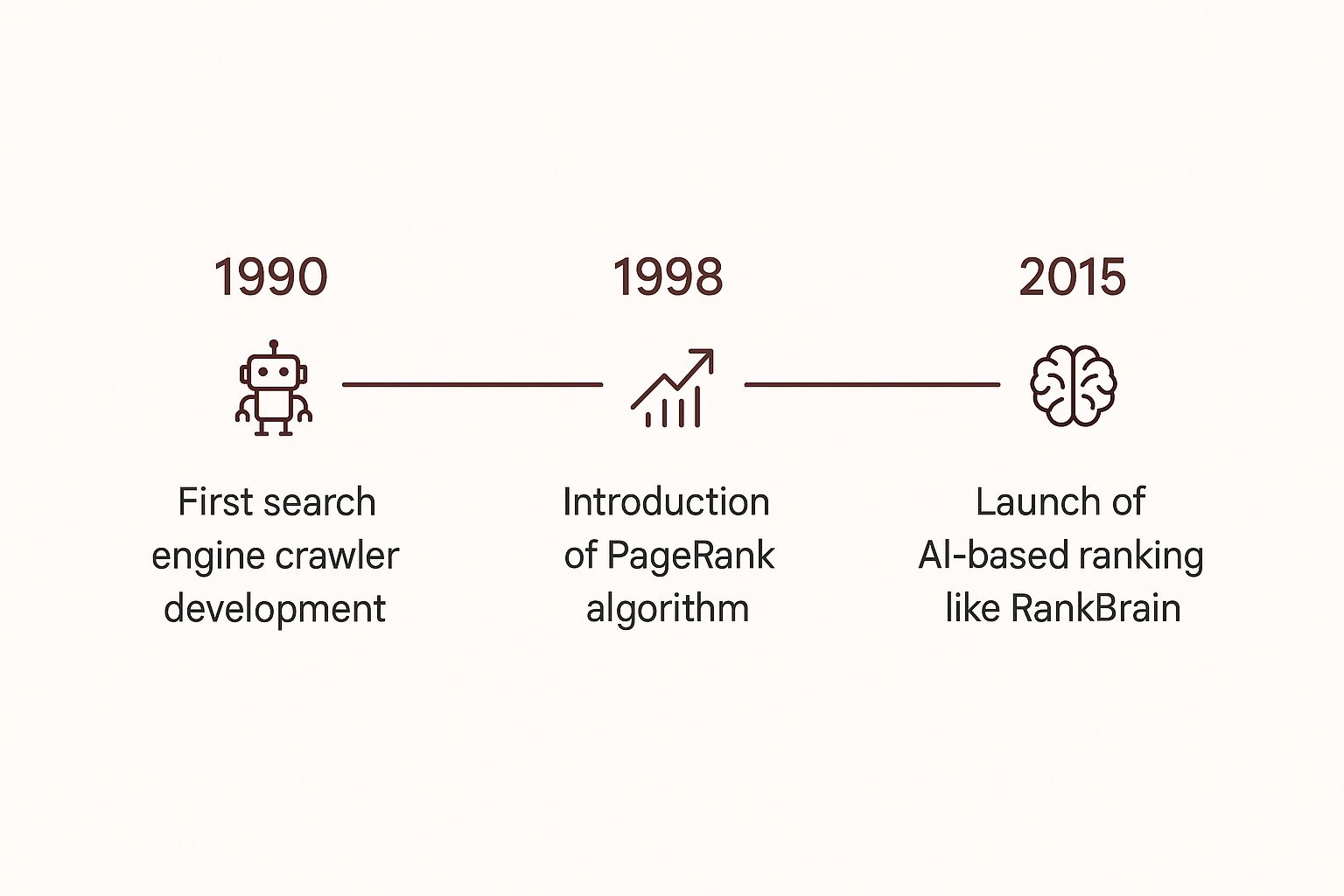
This timeline gives you a quick visual of just how much things have changed.
As you can see, search engines went from being basic text-scanners to incredibly sophisticated AI. Naturally, SEO had to grow up right alongside them.
The Shift from Tricks to Trust
Everything changed when Google showed up in 1998 with its PageRank algorithm. For the first time, a search engine started judging websites based on authority and relevance, mainly by looking at how many other quality sites linked back to them.
This was a massive turning point. Suddenly, it wasn't just about what you said on your own website; it was about how many other people were vouching for you. You can find some fascinating insights about the history of SEO that dig deeper into these early days. This one change forced SEO to evolve from pure manipulation into a real strategy. Instead of just jamming keywords onto a page, smart marketers started thinking about how to earn links from reputable sites. The race to build online authority had begun.
If there’s one big lesson from SEO's history, it's this: trying to game the system is always a short-term play. The search engines eventually catch up, and their goal has always been to reward the websites that deliver the best experience for real people.
The Modern Focus on User Experience
Throughout the 2000s and 2010s, Google dropped a series of game-changing algorithm updates. Each one was designed to smack down websites using sketchy tactics and elevate the ones providing genuine value.
A few of the biggest shake-ups included:
Florida (2003): One of the first major blows against keyword stuffing and other old-school tricks. It was a clear signal that the rules were changing for good.
Panda (2011): This update went after sites with "thin" or low-quality content. It forced everyone to start focusing on creating genuinely useful information.
Penguin (2012): This one targeted spammy, unnatural links, making it crucial to earn high-quality backlinks instead of just buying them or building them on irrelevant sites.
With every update, the industry was pushed further away from quick fixes and closer to building sustainable, user-first strategies. Today, understanding SEO is all about understanding your audience. It's about creating fantastic content, making sure your website works flawlessly, and earning a reputation as a trustworthy source. The old tricks are dead. They’ve been replaced by a smarter, more meaningful approach that puts quality first.
Understanding On-Page SEO for Your Website
Let's start with the part of SEO you have complete, direct control over. On-page SEO covers everything you do on your own website to help it climb the search rankings. It’s all about making your site’s purpose and content unmistakably clear to both search engines and human visitors.
Think of your website like a physical retail store. You wouldn't just scatter products on shelves at random, would you? Of course not. You’d set up clear signs for each aisle (your headings), create descriptive product labels (your title tags), and organize everything so shoppers can find exactly what they're looking for. On-page SEO is just applying that same common-sense logic to your digital storefront.