
Your website is often the first interaction a potential customer has with your business. It's your 24/7 salesperson, your main brand ambassador, and your most visible credibility builder. A site that is just "good enough" no longer cuts it. To truly stand out, especially as a small or local business, you need a website strategically designed to attract, engage, and convert visitors into loyal customers.
Understanding why web design is important is the first step toward building an effective online presence. A great design is not just about looks; it's a powerful business tool that directly influences how people see your brand and whether they choose to interact with it. A poorly designed site can drive potential customers away in seconds, while a well-crafted one can significantly boost engagement, trust, and revenue.
This article breaks down the most critical reasons why investing in quality web design is essential for growth. We will move beyond the basics to provide usable insights you can apply directly to your business. We'll explore the fundamental pillars of web design that impact everything from your search engine rankings to your bottom line, showing you how thoughtful design is one of the smartest investments you can make.
1. First Impressions and Brand Credibility
Your website is often the very first interaction a potential customer has with your business. In the digital world, this first handshake happens in milliseconds, and it's almost entirely visual. This immediate judgment is a critical reason why web design is important; it sets the stage for everything that follows, determining whether a user stays to learn more or leaves instantly.
A professional, modern design shows that you are a legitimate and trustworthy business. Think about it: a cluttered, outdated, or broken website creates an impression of neglect. If you don't care about your own digital storefront, why should a customer trust you to care about their needs? On the other hand, a clean, intuitive, and visually appealing site builds immediate confidence and credibility. It signals professionalism and attention to detail, making visitors feel secure enough to engage, inquire, or make a purchase.
The Data Doesn't Lie
Research consistently shows that users form strong opinions based on looks long before they ever read a single word of your content. Key statistics highlight just how quickly these judgments are made and how much they matter.
The following graphic visualizes the direct link between design, user perception, and business outcomes.
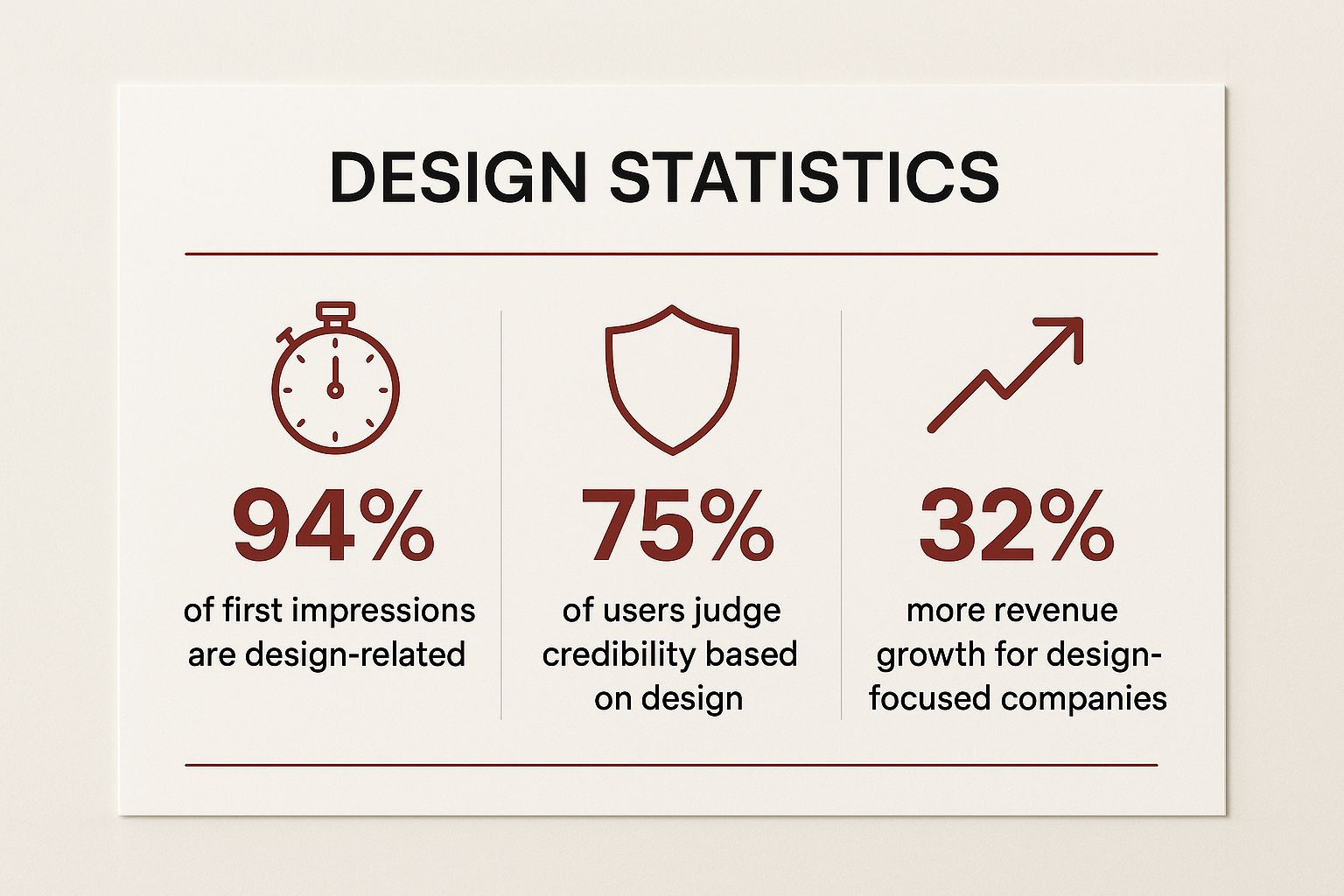
These numbers confirm that a significant majority of your audience will judge your company's credibility based on design alone, reinforcing the direct impact it has on trust and revenue.
How to Build Credibility Through Design
For a small business, building this trust is essential. You can achieve it by focusing on a few key design elements:
- Invest in High-Quality Visuals: Use professional photography of your products, team, or location instead of generic stock photos. This makes your brand feel real and creates a human connection.
- Maintain Brand Consistency: Ensure your logo, color scheme, and typography are used consistently across your entire website. This builds brand recognition and projects a stable, reliable image.
- Display Trust Signals: Prominently feature customer testimonials, industry certifications, partner logos, or security badges (like SSL certificates). These act as third-party endorsements that validate your credibility.
- Prioritize Clarity and Simplicity: Use plenty of white space to create a clean, uncluttered layout. A design that is easy to navigate and understand feels more trustworthy and professional than one that overwhelms the user with information.
- Follow the "Three-Click Rule": A user should be able to find any key piece of information on your site within three clicks. This forces you to create a logical and streamlined site structure.
- Use Descriptive and Clear Labels: Avoid clever or vague terms for your navigation menu. Use familiar words like "Services," "About Us," and "Contact" that users immediately understand.
- Implement a Strong Visual Hierarchy: Guide the user's eye to the most important elements first. Use size, color, and placement to create a clear path of action, such as a prominent "Request a Quote" button.
- Include a Prominent Search Bar: If your site has a lot of content, like a blog or a large product catalog, a highly visible and functional search bar is essential for helping users find exactly what they need.
2. User Experience (UX) and Navigation
Beyond just looking good, your website must be easy and enjoyable to use. This is the core of User Experience (UX) design: creating a seamless, intuitive path that guides visitors to what they need without frustration. Effective navigation is a crucial aspect of why web design is important because it directly impacts how long users stay on your site and whether they complete their goals, such as making a purchase or filling out a contact form.
A confusing or clunky website is a dead end. If a potential customer can't find your product information or contact details quickly, they will simply leave and go to a competitor. Good UX design reduces this friction, making the user's journey feel effortless and logical. It anticipates what the user wants and provides a clear, simple way for them to get there, turning a potentially frustrating search into a satisfying experience.
Why a Smooth Journey Matters
The goal of UX is to make technology feel invisible, letting users accomplish tasks without ever thinking about the interface. When done right, it builds positive feelings toward your brand and dramatically increases conversion rates. A user who has a good experience is far more likely to return and recommend your business.
As usability expert Steve Krug famously wrote in his book, "Don't Make Me Think," your website's navigation should be self-evident. The following video explains the foundational principles of creating an intuitive user experience.
This principle is about removing guesswork, ensuring every click brings the user closer to their intended goal with absolute clarity.
How to Improve Your Website's UX
For a small business, a user-friendly site can be a major competitive advantage. Focus on these practical steps to enhance navigation and overall experience:
3. Search Engine Optimization (SEO)
Your website's design is not just a visual element; it's a foundational pillar of its performance on search engines like Google. Many technical factors that search algorithms analyze are directly contro