
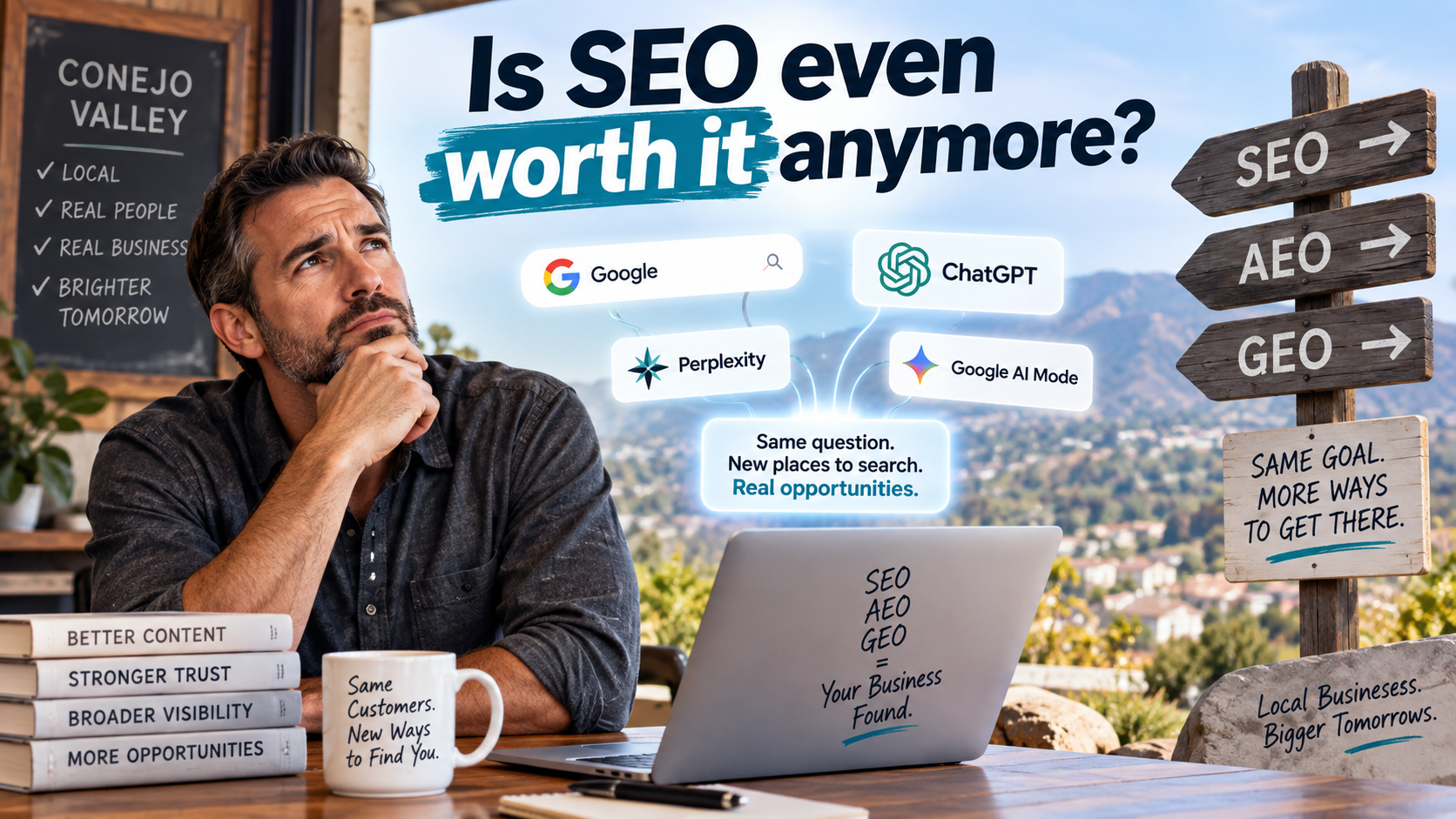
"Is SEO dead?" has been one of marketing's favorite questions for years. Every time Google changes how search works, or a new technology comes along, people assume SEO is finished.
That happened when Google started cracking down on low-quality websites. It happened when mobile search became more important. It happened when voice search took off. It happened when Google began showing more answers directly in search results.
And now it is happening again with AI.
But SEO has not disappeared. It has evolved. Businesses still need to be found when people are looking for answers, services, products, and local providers. The difference is that today, those searches may happen on Google, in Maps, through AI Overviews, or inside tools like ChatGPT.
I hear the same question from business owners almost every week: is this still worth it? Given what is happening with AI and clicks dropping, is SEO still a good investment for my business?
Yes. Here is why the panic is misplaced, and what actually changed.
The click behavior is genuinely shifting. The Pew Research Center, in a July 2025 report that analyzed real browsing data from 900 U.S. adults collected in March 2025, found that users clicked through to a website on just 8% of searches when a Google AI summary appeared, compared with 15% of searches without one. Only 1% clicked a link inside the summary itself. (Pew Research Center, July 2025)
That is a real change. Fewer clicks per search is not a rumor.
But "fewer clicks" is not the same as "SEO is dead." The job changed. You used to optimize to be found. Now you also optimize to be quoted. And somewhere in that shift, the industry did what it always does. It invented new acronyms.
SEO vs AEO vs GEO, honestly
Here is what the three terms actually mean, without the sales pitch.
| Term | Stands for | The goal | Where it plays out |
|---|---|---|---|
| SEO | Search Engine Optimization | Be found. Rank in the list of results. | Google, Bing, Maps |
| AEO | Answer Engine Optimization | Be the answer. Get pulled into the direct response. | Featured snippets, voice assistants, AI Overviews |
| GEO | Generative Engine Optimization | Be cited and recommended by generative AI. | ChatGPT, Perplexity, Gemini, Google AI Mode, Copilot |
Now the part most articles will not tell you. These are not three different disciplines. They are one discipline with three emphases.
SEO literally means search engine optimization, which is optimizing so that a search engine can find, understand, and trust your business. That definition never stopped applying. ChatGPT is a search engine now. So is Perplexity. So is the AI layer sitting on top of Google. The engines changed shape. The job description did not.
You could call the whole thing SEO and lose nothing. Plenty of serious practitioners do.
Whether we call it SEO or AEO, at the end of the day the whole point is to be found when somebody searches for you. The change is that they are not typing it into the search bar on Google. They are typing it into ChatGPT, Gemini, or somewhere else. AI is not pulling from somewhere secret. They are still taking the information that is out there.
Leena Roy, Founder, Digital Lotus Marketing
What did not change (and this is most of it)
Strip away the acronyms and the foundations are identical to what they were five years ago.
Good content still wins. Content that genuinely answers what a real person is asking. AI did not lower that bar. It raised it, because thin filler content has nothing worth quoting.
Technical health still matters. A site the engine can crawl, load, and parse. If a machine cannot read your page, it cannot rank you or cite you. What I tell clients: a disorganized technical backend is a real disadvantage now, and it is the non-negotiable piece.
Trust signals still decide close calls. Reviews, mentions on other credible sites, consistent business information, real expertise from a real person. AI systems are, if anything, more dependent on corroboration than the old ten blue links were. They need multiple sources agreeing before they will put your name in an answer.
Being useful to actual humans is still the whole strategy. Every algorithm change of the last fifteen years has moved in the same direction: reward the sites that genuinely serve the person who showed up. AI accelerated that. It did not reverse it.
If someone tells you AI search means throwing out your SEO foundation and starting over, they are selling something.
What actually changed: five subtle shifts in execution
The differences are real. They are just smaller and more specific than the headlines suggest. This is where SEO vs AEO vs GEO stops being a semantic argument and starts being practical.
1. Structure moved from nice-to-have to essential
A machine extracting an answer needs to find it fast. That means a clear question as a heading with a direct answer immediately underneath, not buried in paragraph four after the throat-clearing. Same information, different architecture. It is why our new posts lead with real FAQs, and why we are going back through older content and rewriting it to answer questions the way people actually ask them.
2. Schema markup earns its keep
Structured data has always been the polite way to hand a machine your facts (your services, your hours, your location, your FAQs) in a format it does not have to guess at. It used to be a modest bonus. Now it is how you avoid being misread.
3. Off-site presence carries more weight
Generative engines corroborate. They want to see your business referenced across multiple independent sources before they will recommend you: directories, associations, review platforms, local press, your Google Business Profile. For local businesses in particular, an active and well-maintained Google Business Profile, plus a steady flow of detailed reviews, is doing more work than it ever has. A single strong website is now a weaker position than it used to be.
4. The measure of success shifted
Ranking #3 for a keyword tells you less than it used to. What matters now is whether you get mentioned in the AI Overview, in the ChatGPT answer, in the Perplexity citation list. That requires actually checking. We now track the top ten questions a real customer would ask an AI in a client's category, and we measure how often the client shows up in those answers. Traffic and clicks are no longer the only scoreboard. Phone calls, form fills, and qualified inquiries are.
5. Fewer visitors, better visitors
The Pew data says clicks are down. But a Semrush AI search traffic study published in July 2025 found the average AI search visitor was worth roughly 4.4x the average traditional organic search visitor. That makes intuitive sense. Someone who arrives because an AI just recommended you is pre-qualified in a way a keyword searcher is not. Judging your SEO purely on session counts will increasingly mislead you.
This is not a small audience anymore
If you still think AI search is a niche behavior, the data has moved. BrightLocal's Local Consumer Review Survey, published in March 2026 and based on a survey of 1,002 U.S. adults, found that 45% of consumers used AI tools for local business recommendations in the past year, up from 6% in 2025. ChatGPT accounted for 31% of that usage, and Google AI Mode for 23%. Of AI users, 63% said they trust the recommendations they get.
That is a nine-month behavior shift, not a five-year one. For a service business in Thousand Oaks or Newbury Park, that means a real chunk of the people looking for what you do are asking an AI about you before they ever see your Google Business Profile. If the AI cannot find you, or finds thin information about you, you are invisible for that share of demand.
So which one should you actually be doing?
All of it, and do not overthink the labels.
Here is the practical test. If a change would make your site clearer, more credible, and more useful to a real customer, it also helps you in AI. That is not a coincidence. It is the entire mechanism. AI systems are trying to predict which business a human would actually be glad to be sent to.
The businesses winning in AI search right now are not the ones who bought a GEO package. They are the ones with a clean site that answers real questions, an active Google Business Profile, a steady stream of detailed reviews, and a presence in more than one place on the internet. Which is to say, they are doing SEO. Well. On purpose.
We wrote up what that actually looks like for a local business in our companion piece on AI visibility for local businesses in the Conejo Valley and Ventura County. Same idea, more checklist.
FAQ
Is SEO dead in 2026?
No. Search behavior changed. The Pew Research Center's July 2025 report found people click through to websites on 8% of searches with an AI summary versus 15% without. But the work of making a business findable and credible to search engines is more valuable than ever, because AI systems build their answers from exactly those signals. What is dead is treating SEO as a game of keywords and rankings alone.
What is the difference between SEO, AEO, and GEO?
SEO (search engine optimization) is about being found in search results. AEO (answer engine optimization) is about being the direct answer in snippets, voice results, and AI Overviews. GEO (generative engine optimization) is about being cited and recommended by generative AI tools like ChatGPT and Perplexity. In practice they share the same foundations (quality content, technical health, structured data, trust signals) and differ mainly in how content is structured and where results are measured.
Do I need to hire a separate GEO agency?
Almost certainly not. GEO is not a separate technology stack. It is a set of emphases within good SEO. An agency that understands both traditional search and how AI systems select and cite sources can handle it in one engagement. Be skeptical of anyone selling AI visibility as an add-on product disconnected from your core search work.
Does AI search mean I will get less traffic?
Probably fewer clicks per search, yes. But the visitors who do arrive from AI tend to convert better. A Semrush AI search traffic study published in July 2025 put the average AI search visitor at roughly 4.4x the value of the average traditional organic visitor. The right response is to stop measuring SEO on raw sessions alone and start tracking mentions, citations, and lead quality alongside traffic.
How do I know if my business is showing up in ChatGPT or Google AI Mode?
By asking. Type the ten questions a real customer in your category would ask into ChatGPT, Perplexity, Google AI Mode, and Gemini, and see whether your business is mentioned and how you are described. Do it monthly. That is the new ranking report. If you would rather not do it manually, our free AI Visibility Scorecard runs the same check across the major AI tools and tells you where you stand.
Getting found is still the job
The acronyms will keep multiplying. The foundations will not move: be genuinely useful, be technically sound, be easy for a machine to read, and be trusted in more than one place. It is still about content, and it is still about doing all the right fundamental SEO practices, done well and on purpose.
If you want to know where your business stands right now, on Google and inside the AI tools, run our free AI Visibility Scorecard. It takes a few minutes and tells you exactly what ChatGPT, Perplexity, and Google AI Mode are saying about you today.